

Share
25th June 2019
04:13pm BST

"I remember saying, well I won't say the [exact] amount, but I put an amount on the card and said, 'Until that is finished, don't come back to me'. And she came back inside of 40 minutes, I was like, 'What?!' "The next instruction I gave her was, 'No doubles! Just pints, beers, singles and let's see how long this goes'."On a recent episode of TKO, women's boxing and MMA star Heather Hardy joined Frampton and host Chris Lloyd to talk about the fight business. During the show, Frampton spoke about fight purses and how much of a cheque usually ends up with the man or woman that steps inside the ring to face the music. [caption id="attachment_201054" align="aligncenter" width="640"]
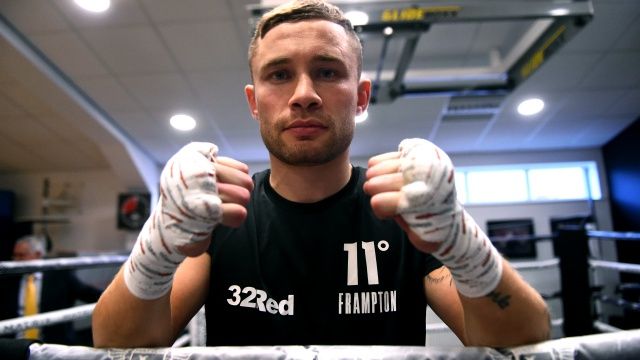 (Photo by Nathan Stirk/Getty Images)[/caption]
"Your outlay depends on where you are at," Frampton says.
(Photo by Nathan Stirk/Getty Images)[/caption]
"Your outlay depends on where you are at," Frampton says.
"For me to be fighting in big title fights, your trainer gets 10%. Your manager normally gets 25%. That is the amount in most circumstances. "Then you have to pay sparring partners. Sometimes you can get sparring partners who are looking to get [ready] for other fights, who you don't have to pay. You have to pay for your food. You have to eat clean, which is sometimes expensive. "Then there's your digs, if you are travelling away from home. And travel expenses, and getting to and from training. "Sometimes what sound like a good purse at the time - someone might say to you that they'll give you 20-grand - by the time you break it down and you're paying taxes on it, it is not a lot of dough."Looking at that breakdown, fighters would then be fortunate if they were to come out with close to half of that €20,000 cheque, and that is a good lump of money for most boxers to receive. On top of that, most elite boxers would fight about three times a year. It makes sponsorship and outside interests, like coaching or media work, all the more vital to keep these athletes going. CHECK OUT THE FULL HEATHER HARDY & CARL FRAMPTON CHAT:
Explore more on these topics:

Boxing | SportsJOE
boxing