

Share
12th December 2021
01:04pm GMT

"I remember the day the announced that I was the new presenter of Formula One, my wife rang me in tears. She said, 'I've just gone on the internet, and everyone thinks you're going to be shit'. "I asked where she had read that and she said, 'On the BBC website'. I went to look and there was this whole message board basically saying. 'Why is this kids TV presenter doing the job?'"It was during his time covering F1 for the BBC that Humphrey started to talk to the top players in the sport about what drove them to success, as well as other Team principals, celebrities and businesspeople that exist in Formula One's glitzy orbit. In time, it would lead to what has become a hugely popular podcast. [caption id="attachment_243927" align="aligncenter" width="594"]
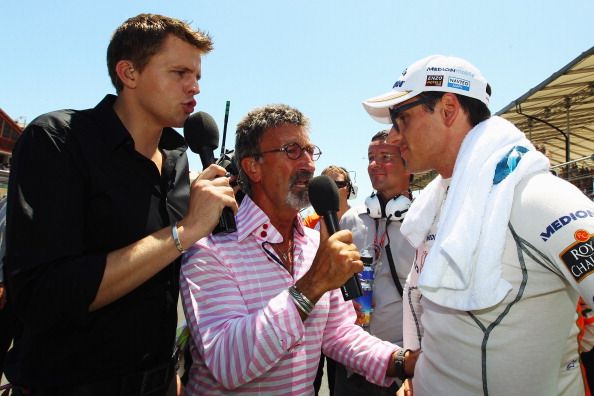 Adrian Sutil (R) of Force India is interviewed by Eddie Jordan (C) and Jake Humphrey (L) of the BBC in 2011. (Photo by Clive Rose/Getty Images)[/caption]
"I had this fixed mind-set that you're either born into this rich family, inherited your dad's business, or you had this innate ability or natural gift for doing whatever you do, or you haven't. "I just assumed that I hadn't, because I came from a real normal family. My mum was a teacher, my dad was a charity worker and we came from this little village in Norfolk. "Then I ended up covering Formula One for the BBC [eight years after my first presenting job there], and even then I had no real belief, for me, that life could be one of high performance and high achievement. The only reason why I ended up there was that I had failed my A Levels and had to go back to repeat them. When I was doing my re-takes, there was a local channel that was looking for people. Because I was still in Norwich and all my mates had gone off to university, or to do their gap years, I was left behind, feeling like an abject failure. I thought, 'I might as well do something interesting with my time'."Humphrey worked on shows like Rule The School and Fame Academy before he branched in sports presenting and covered football, athletics and American Football. When he did land the Formula One gig, he quizzed the great and good that he rubbed shoulders with about how they landed there. "I'd ask these people, 'What do you think is the secret to your success?' They always seemed to come up with similar answers." Humphrey discovered:
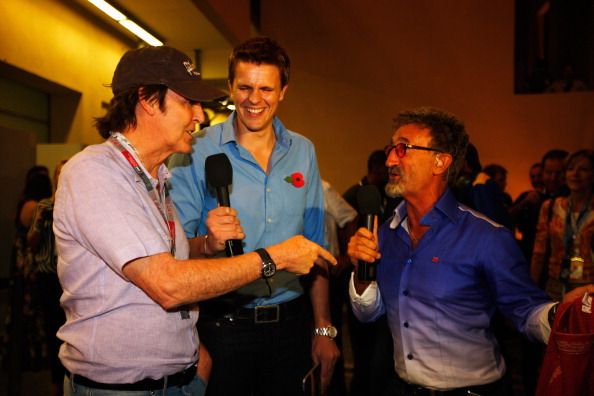 Jake Humphrey and Eddie Jordan chat with Beatles legend Paul McCartney in 2011. (Photo by Mark Thompson/Getty Images)[/caption]
"Dan Carter was an awesome one," says Humphrey. "He was following us on Instagram and we were like, ‘Why is Dan Carter following High Performance on Instagram?’ And, it turns out, he was in New Zealand listening to the bloody podcast, and enjoying the podcast. "‘Do you want to come on it?’ ‘Yeah, I’d love to come on and share my thoughts’."That’s a really nice moment, but the really, really good stuff for us is when people are sort of challenged... I always say, ‘Ask a question of everyone you meet, because everyone knows something you don’t’. And I think that people will find, we speak to Jonny Wilkinson and we don’t mention rugby, we speak to Matthew McConaughey and we don’t mention acting. "We sit down for a conversation with Gareth Southgate, we don’t talk about football. We talk about non-negotiable behaviours, we talk about leadership, we talk about inspiring people, building a team around you, we talk about criticism, about building self-confidence. "Like, we had Gareth Southgate sitting there, saying, ‘Your podcast got me through lockdown’. And I’m thinking, shit, man, this is the England boss. How is it possible the England boss is saying that High Performance got him through lockdown? That is mad. Mad." [caption id="attachment_243926" align="aligncenter" width="594"]
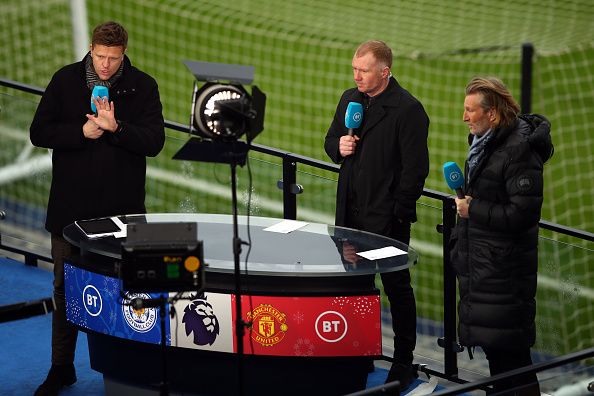 Jake Humphrey with BT Sports pundits Robbie Savage and Paul Scholes at The King Power Stadium in December 2020. (Photo by Marc Atkins/Getty Images)[/caption]
"If you listen to High Performance, you will realise that successful people fail way more than anyone else. They exist in that part where failure is almost inevitable. It’s the same reason as when you go to the gym and your personal trainer says, Lift that weight to failure’. Well, why? It’s because it’s so you can lift it heavier, lift it longer. You’re stronger, you build through failure. "If I go back through my own journey, I was badly bullied at school and had to move schools when I was 13, or something. And then I failed my A-Levels and had to go back and re-take them. I got fired from McDonalds for having a lack of communication skills.""And when you get into broadcasting," he adds, "or think that’s what you want to do, and you have a stack of 30 or 40 - and I’ve still got them in the basement - rejection letters. Now, you can look at all of those things as negatives, or you can look at them as positives. "We talk in the podcast about taking responsibility, and 100% responsibility, about your reaction to those set-backs and how you are in complete control of. It’s actually up to you, whether all of those things you go through are negatives and problems, or positives that you learn and grow from." High Performance: Lessons From The Best On Becoming Your Best (by Jake Humphrey & Prof. Damian Hughes), published by Random House, is available to buy in hardback, as well as an eBook or audio book.
Explore more on these topics:


