

Share
11th September 2021
11:33am BST

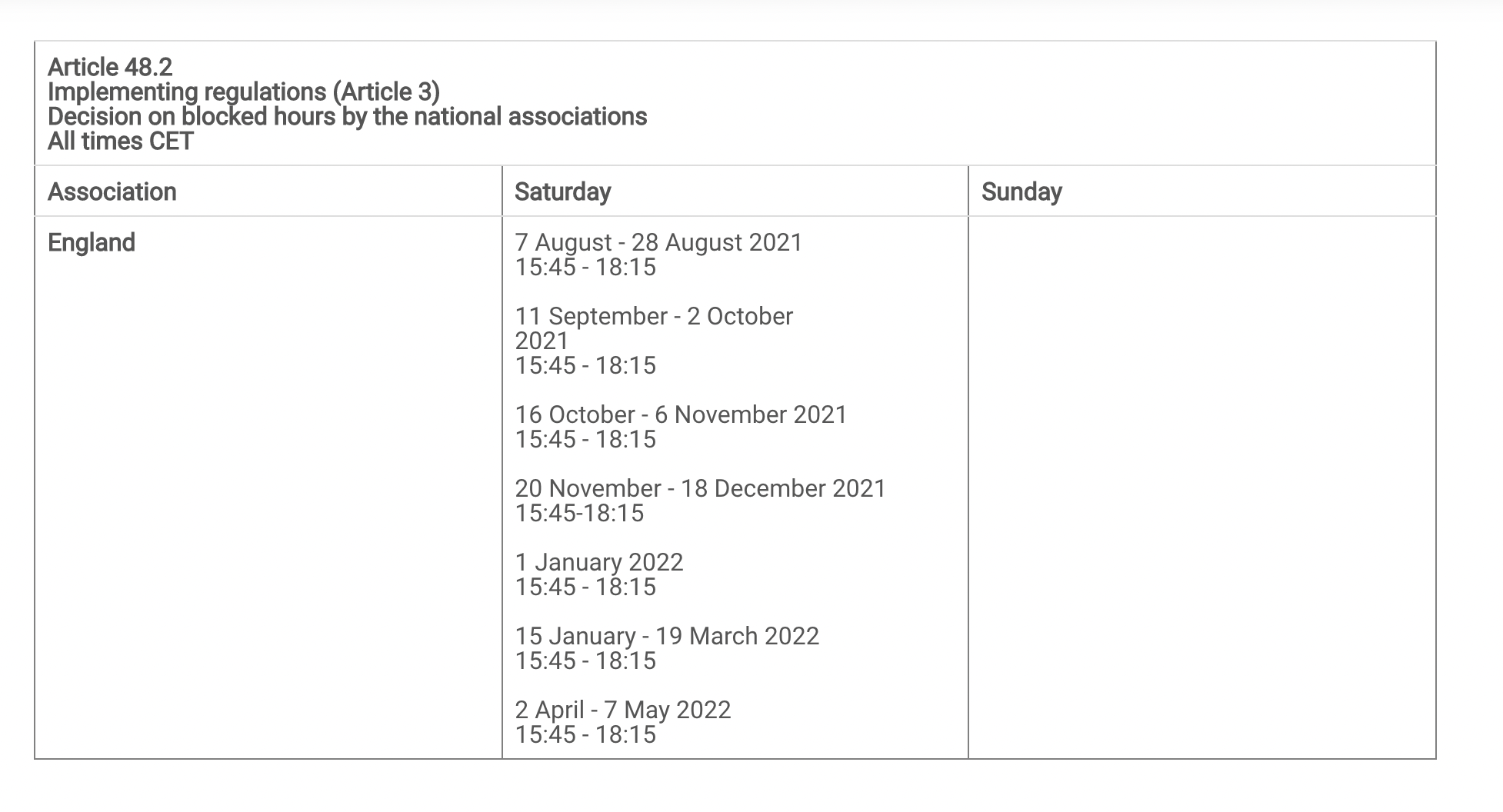 The blackout, it was hoped, would protect attendances in the grounds by ensuring fewer distractions for those football fans who might choose to watch a game on TV as an alternative to watching a game at a stadium. In addition, UEFA also thought it might encourage more fans to participate in the game at grassroots level.
The FA opted for the 2.45-5.15pm window on Saturdays to protect the 3pm kick-offs that have traditionally taken place throughout its professional game and the tiers below.
Why, then, is it only English football that sees fit to apply the broadcast ban? Why aren't other European nations doing the same if this is deemed so necessary? Put simply, English football is a unique case. Its football pyramid has four professional leagues on top of multiple semi-professional tiers. None of UEFA's other member nations have a system that is quite so extensive.
More pertinently, as pointed out by the excellent in-depth Twitter thread by ESPN's Dale Johnson, other nations wouldn't qualify for such a blackout in any case. Elsewhere on the continent, staggered kick-off times across the weekend means there is little overlap between televised broadcasts and other games from lower divisions.
https://twitter.com/DaleJohnsonESPN/status/1435194642350411778
The arguments against the blackout's relevance in the modern game largely centre on one simple point: why, when the rest of the world is able to watch a 3pm kick-off in the Premier League, should people living in the country in which the game is taking place not be able to?
Such frustration is, to an extent, understandable, but ignores the potential impacts it might have on England's complicated football ecosystem. While match-day revenue is less important to the leading lights of the Premier League than it was 20 years ago, its importance increases significantly the lower down the divisions you drop.
Ashton United of the Northern Premier League - the seventh tier of English football - are based only a few miles from Old Trafford. Their home game with Buxton kicks off at precisely the same time as Ronaldo's potential United return on Saturday afternoon. As with many clubs competing at this level, match-day revenue is the lifeblood that enables them to operate.
The blackout, it was hoped, would protect attendances in the grounds by ensuring fewer distractions for those football fans who might choose to watch a game on TV as an alternative to watching a game at a stadium. In addition, UEFA also thought it might encourage more fans to participate in the game at grassroots level.
The FA opted for the 2.45-5.15pm window on Saturdays to protect the 3pm kick-offs that have traditionally taken place throughout its professional game and the tiers below.
Why, then, is it only English football that sees fit to apply the broadcast ban? Why aren't other European nations doing the same if this is deemed so necessary? Put simply, English football is a unique case. Its football pyramid has four professional leagues on top of multiple semi-professional tiers. None of UEFA's other member nations have a system that is quite so extensive.
More pertinently, as pointed out by the excellent in-depth Twitter thread by ESPN's Dale Johnson, other nations wouldn't qualify for such a blackout in any case. Elsewhere on the continent, staggered kick-off times across the weekend means there is little overlap between televised broadcasts and other games from lower divisions.
https://twitter.com/DaleJohnsonESPN/status/1435194642350411778
The arguments against the blackout's relevance in the modern game largely centre on one simple point: why, when the rest of the world is able to watch a 3pm kick-off in the Premier League, should people living in the country in which the game is taking place not be able to?
Such frustration is, to an extent, understandable, but ignores the potential impacts it might have on England's complicated football ecosystem. While match-day revenue is less important to the leading lights of the Premier League than it was 20 years ago, its importance increases significantly the lower down the divisions you drop.
Ashton United of the Northern Premier League - the seventh tier of English football - are based only a few miles from Old Trafford. Their home game with Buxton kicks off at precisely the same time as Ronaldo's potential United return on Saturday afternoon. As with many clubs competing at this level, match-day revenue is the lifeblood that enables them to operate.
"Match day attendance is a massively important thing for us," Vice Chairman Steve Hobson tells JOE. "It can be difficult. We’re in a borough with five clubs playing at a similar level, all competing with each other, and that’s before you factor in United, City, Oldham, Rochdale, Bury, Burnley, Bolton and all the rest, too.
 "We strive to improve our match attendances all the time. We’d probably lose fans when United are at home at the same time anyway because of how close we are to them. But if 3pm games from the Premier League were to start being shown on the TV too, that attendance would be even lower because people will stop at home and watch it. It would be damaging for clubs like ours.
"At this level, it isn’t just attendance money. It's things like bar spend, food and raffles. All these things are crucial for us, but only make us money if the fans are there in the ground in the first place."
https://twitter.com/AshtonUnitedFC/status/1435934108430053384 Hobson adds that the current Premier League TV schedule, in which games are played before and after the traditional 3pm games on a Saturday, is something which actually plays into the hands of clubs such as Ashton United."It’s not an issue when United or another big team are on after us," he explains. "It actually helps us, as people will stay on in the bar after our game’s finished and watch it here. That results in additional spend for us, which is huge.
"Even the early 12:30 kick-off helps us. We’ll try and create a match-day package for fans. They can come and watch the televised games in the bar and our game live in the middle of them.
"We’ll promote that and encourage them to make a day of it. Our strategy, as it has to be, is to try and keep fans in the ground.
"Obviously, this becomes very difficult if fans have the option of staying at home and watching the 3pm kick-offs too. It would be a real problem for us."
Quantifying the precise economic impact on clubs lower down the pyramid is impossible. The blackout has been in place for too long and football has changed beyond recognition in that time. Ask those affiliated with lower league and non-league clubs if there would be financial repercussions for them, however, and all will agree that it would amount to something. We will, of course, never know how damaging such a move would be unless it happens, but at a time when the sport's finances are more delicate than ever before thanks to the pandemic, when more clubs than ever teeter on the brink of financial oblivion, now simply isn't the time to take such a gamble. Those not inside Old Trafford on Saturday will have to wait for Match of the Day to (legally) watch Ronaldo's return. For now, too many rely on games not being screened in that 2.45 to 5.15pm window. Whether English football's governing bodies eventually cave to the demands of the modern football fan and do away with the blackout only remains to be seen.Explore more on these topics:


