

Share
13th February 2024
03:55pm GMT

"So," Trimble remarked, "you stole hurling from us, and we stole Ulster from you? So, it's even?!" "I would say we won, to be honest!" McManus shot back.Andrew Trimble: For Ulster & Ireland delved into how the former rugby star views his own cultural identity, and how others living in Northern Ireland view theirs, and how some people have been pushed towards tribalism thanks to a fraught, bloody past. During the riveting documentary, available to watch on the RTÉ Player, Trimble revealed to Barry Murphy, another retired rugby star, how Ireland used to play every second home 'Test' match in Belfast, and even stood for a 'home' anthem of God Save the Queen. [caption id="attachment_297937" align="aligncenter" width="799"]
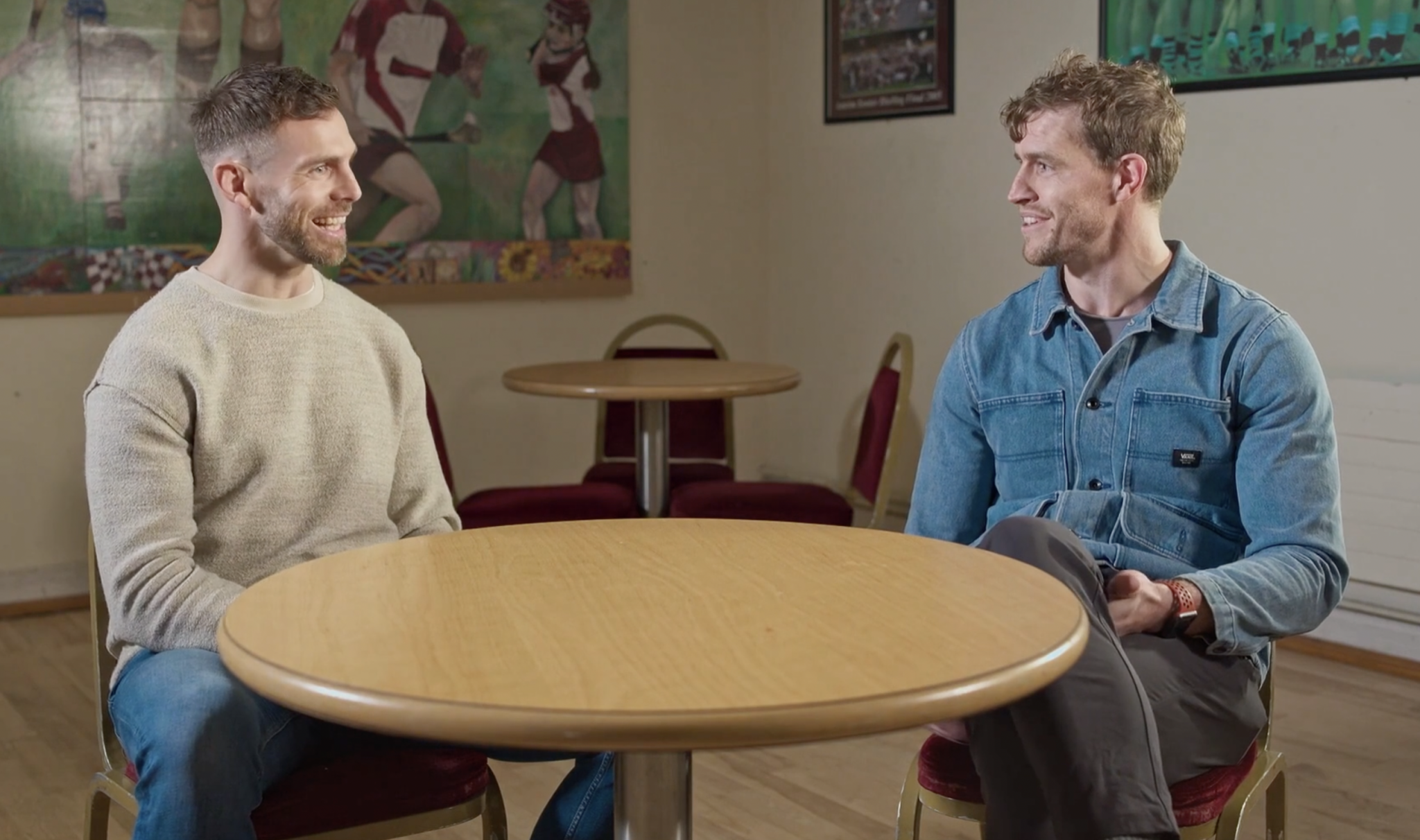 Former Antrim hurling captain Neil McManus chats with Andrew Trimble. (Credit: RTE)[/caption]
'Knowing what a long and divisive shadow political, cultural and religious tribalism has cast across his homeland, Trimble wants to know if key events in his lifetime – The Troubles, the Good Friday Agreement, Brexit and the on-going political turbulence – have changed those attitudes and affiliations. 'For him, this is a home fixture, but for Barry, seeing the Union Jacks, murals and painted kerbstones of Down and Antrim, he might as well be in a foreign country. Scotland is clearly in sight across the water and Limerick suddenly feels a long way away, but Barry still can’t understand why people whose families have lived on the island of Ireland for centuries should identify more readily with the culture of the island next door, especially when so many more recent arrivals are only too happy to embrace Irishness.'Trimble met, and chatted with, historians, protestants, catholics, members of the Orange Order, a hurler (Neil McManus), the adult offspring of three political titans: John Hume, Ian Paisley and David Trimble. He then visited Croke Park with Murphy, as he recalls playing in an historic Ireland win over England - at GAA headquarters - that featured 80,000 people standing in respectful silence for God Save the Queen.
"Up until the 1950s, they used to play alternate Ireland internationals in Belfast and Dublin and, when they played in Belfast [at Ravenhill], they used to play God Save the Queen... that was the IRFU protocol, at the time. It was an all-Ireland rugby team. There was partition in 1921 and that was the compromise." "That is an incredible compromise," declared Murphy. "I could never imagine that happening."Murphy was not the only person left stunned by that anthem fact, with social media soon flooded with remarks and reactions. The anthem that would have primarily played at those Ravenhill games would have been 'God Save the King' but 'God Save the Queen' - for Elizabeth II - would have played ahead of the Five Nations game between Ireland and France, in 1953. https://twitter.com/RTEOne/status/1757027840870986143 In 1995, ahead of the Rugby World Cup in South Africa, the IRFU commissioned Phil Coulter to come up with a song that encompassed all four provinces, and was about the inclusivity of different cultures. He came up with Ireland's Call, and it has featured in Test matches ever since, and is the sole anthem played when Ireland are away from home. Last weekend, young Stevie Mulrooney gave rousing rendition of the anthem before Ireland's 36-0 win over Italy.
Explore more on these topics:


