

Share
11th November 2014
09:24am GMT

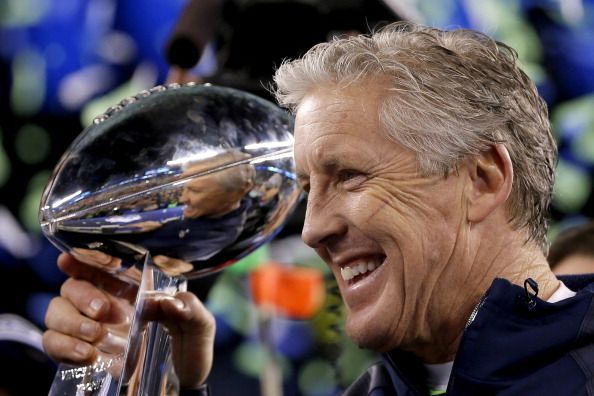 One outcome that Gervais played a part in was the Seattle Seahawks' Super Bowl XLVIII win in February over the Denver Broncos and Peyton Manning. The Seahawks are coached by Pete Carroll, pictured above, a man who Gervais says is much more than the enthusiastic rabble rouser we see on the sidelines of NFL games.
'He is relentless in making his players the very best they can be in life and sport,' says Gervais with real affection in his voice. 'It is a joy to work with someone so like-minded'
And what was the key to their success last season? Well, it was treating every game, every moment in fact, like it was the Super Bowl.
'Coach Carroll began the season as ‘this is a championship practice, this is a championship game in preseason, and the first game of the season was another championship game. So, when it came to the Super Bowl, it was another championship opportunity, no different to any other game,' he says before adding with a smile, 'just more media'.
And when we posed the obvious question: 'So, did you take much satisfaction from the Seahawks winning the Super Bowl?' the answer shouldn't have surprised us. 'It was another moment. It was a wonderful celebration of the collective effort.'
Above all else, Gervais believes in 'the moment'. Embrace the moment, control the moment, live in the moment and you won't go far wrong is his mantra. It is a breathtakingly simple idea that most of us struggle to adhere to.
Gervais has spoken many times about the value of 'the moment'. 'There’s nothing better than an uncomfortable moment because in that moment we’re incredibly aware of ourselves,' is one of his quotes, while another is: 'There’s no such thing as a big moment, there’s another moment.'
We put it to him that for footballers who play every week, they could possibly live in the moment far more comfortably as they know there was a whole bunch of moments coming up, be it the next play, the next game, the next season. What about Olympians, or other athletes whose careers may hinge on one, well, moment every four years.
'Often times it is not four, it is eight or 10 years and they’ve invested so much into the process that it is the wrong way to think about that a moment will define you. The process is to invest in a moment-to-moment experience of being present and having access to the skills and abilities that you have.'
And how do you do that, how do you convince yourself of that?
'What changes is the environment. The difference between the Olympics and practice is that more people are watching. Do you want to change your entire way of thinking because someone is watching you? Everybody I have met says no.'
One person Gervais worked with faced a challenge, a moment, unlike any other. When Felix Baumgartner leapt from the Red Bull Stratos balloon 24 miles up in October 2012, it was only possible after Gervais had helped him overcome a phobia of the special suit he would have to wear to survive the jump. Was Gervais surprised that a man who to our eyes was the bravest in the world would be afraid of anything?
'When people push deep into their potential they bump up against their limits and fear is part of that process. Having the courage to be able to stay with it while it is incredibly intense and real fear requires incredible courage.'
To help Baumgartner manage his thoughts, Gervais himself got into the specially designed space suit, so he could comprehend fully what the Austrian was experiencing.
'Everyone has a unique experience. My experience? An enclosed environment that required outside support,' he says with a look that says it was not pleasant in any way, shape or form.
'We applied well researched science to extinguish fear. He did the work and faced his fear. What he accomplished was life-altering.'
Gervais's philosophy is not just one for elite athletes or boundary pushers, or even exclusive to sports people. Everyone can become high-performance, regardless of the field.
'The level of sport doesn’t matter. If we can value the arc of progression more than the outcome itself we can reorientate ourselves to be better. What are we trying to get better at? That's a central question in creating a plan.
'We’re all working on the same mental skills. Can we have greater awareness of our internal monologue? Can we let go of conversations that are feeding doubt feeding fear and can we invite a dialogue that explores what is possible, what is now and live more connected to the moment? The mechanics of building confidence, that in front of me is possible.'
Before we go, we ask Gervais for a few simple tips for the average person to begin the process of getting a handle on our mind.
'I ask my athletes to begin their day with one breath to centre themselves, with one, minimum, thought of gratitude about their lives, one intention for the day and then when your feet hit the ground just feel your feet, be present. It is a simple little process.'
Indeed it is. And, despite what he says, we wonder if Ian Poulter hasn't had a sneaky Google of sports psychology and Dr Gervais. In the same Telegraph interview where Poulter says he would never use a sports psychologist, Poulter recalls his famous match at Medinah in the 2012 Ryder Cup singles against Webb Simpson.
'It was a moment. I’m not sure I knew it was going to happen. You never break it down when you’re playing – I need to birdie the last five to give us a chance – you just try to hit every shot.'
Just 'a moment'. We reckon Dr Mike Gervais might be on to something...
Dr Michael Gervais was speaking to us as part of his role with Guinness and their new ad campaign ‘Munster: Self Belief’
https://www.youtube.com/watch?v=CyNWKsuchaU
One outcome that Gervais played a part in was the Seattle Seahawks' Super Bowl XLVIII win in February over the Denver Broncos and Peyton Manning. The Seahawks are coached by Pete Carroll, pictured above, a man who Gervais says is much more than the enthusiastic rabble rouser we see on the sidelines of NFL games.
'He is relentless in making his players the very best they can be in life and sport,' says Gervais with real affection in his voice. 'It is a joy to work with someone so like-minded'
And what was the key to their success last season? Well, it was treating every game, every moment in fact, like it was the Super Bowl.
'Coach Carroll began the season as ‘this is a championship practice, this is a championship game in preseason, and the first game of the season was another championship game. So, when it came to the Super Bowl, it was another championship opportunity, no different to any other game,' he says before adding with a smile, 'just more media'.
And when we posed the obvious question: 'So, did you take much satisfaction from the Seahawks winning the Super Bowl?' the answer shouldn't have surprised us. 'It was another moment. It was a wonderful celebration of the collective effort.'
Above all else, Gervais believes in 'the moment'. Embrace the moment, control the moment, live in the moment and you won't go far wrong is his mantra. It is a breathtakingly simple idea that most of us struggle to adhere to.
Gervais has spoken many times about the value of 'the moment'. 'There’s nothing better than an uncomfortable moment because in that moment we’re incredibly aware of ourselves,' is one of his quotes, while another is: 'There’s no such thing as a big moment, there’s another moment.'
We put it to him that for footballers who play every week, they could possibly live in the moment far more comfortably as they know there was a whole bunch of moments coming up, be it the next play, the next game, the next season. What about Olympians, or other athletes whose careers may hinge on one, well, moment every four years.
'Often times it is not four, it is eight or 10 years and they’ve invested so much into the process that it is the wrong way to think about that a moment will define you. The process is to invest in a moment-to-moment experience of being present and having access to the skills and abilities that you have.'
And how do you do that, how do you convince yourself of that?
'What changes is the environment. The difference between the Olympics and practice is that more people are watching. Do you want to change your entire way of thinking because someone is watching you? Everybody I have met says no.'
One person Gervais worked with faced a challenge, a moment, unlike any other. When Felix Baumgartner leapt from the Red Bull Stratos balloon 24 miles up in October 2012, it was only possible after Gervais had helped him overcome a phobia of the special suit he would have to wear to survive the jump. Was Gervais surprised that a man who to our eyes was the bravest in the world would be afraid of anything?
'When people push deep into their potential they bump up against their limits and fear is part of that process. Having the courage to be able to stay with it while it is incredibly intense and real fear requires incredible courage.'
To help Baumgartner manage his thoughts, Gervais himself got into the specially designed space suit, so he could comprehend fully what the Austrian was experiencing.
'Everyone has a unique experience. My experience? An enclosed environment that required outside support,' he says with a look that says it was not pleasant in any way, shape or form.
'We applied well researched science to extinguish fear. He did the work and faced his fear. What he accomplished was life-altering.'
Gervais's philosophy is not just one for elite athletes or boundary pushers, or even exclusive to sports people. Everyone can become high-performance, regardless of the field.
'The level of sport doesn’t matter. If we can value the arc of progression more than the outcome itself we can reorientate ourselves to be better. What are we trying to get better at? That's a central question in creating a plan.
'We’re all working on the same mental skills. Can we have greater awareness of our internal monologue? Can we let go of conversations that are feeding doubt feeding fear and can we invite a dialogue that explores what is possible, what is now and live more connected to the moment? The mechanics of building confidence, that in front of me is possible.'
Before we go, we ask Gervais for a few simple tips for the average person to begin the process of getting a handle on our mind.
'I ask my athletes to begin their day with one breath to centre themselves, with one, minimum, thought of gratitude about their lives, one intention for the day and then when your feet hit the ground just feel your feet, be present. It is a simple little process.'
Indeed it is. And, despite what he says, we wonder if Ian Poulter hasn't had a sneaky Google of sports psychology and Dr Gervais. In the same Telegraph interview where Poulter says he would never use a sports psychologist, Poulter recalls his famous match at Medinah in the 2012 Ryder Cup singles against Webb Simpson.
'It was a moment. I’m not sure I knew it was going to happen. You never break it down when you’re playing – I need to birdie the last five to give us a chance – you just try to hit every shot.'
Just 'a moment'. We reckon Dr Mike Gervais might be on to something...
Dr Michael Gervais was speaking to us as part of his role with Guinness and their new ad campaign ‘Munster: Self Belief’
https://www.youtube.com/watch?v=CyNWKsuchaUExplore more on these topics:

Us Sports | SportsJOE
us sports


